FengInvest
Three paths, one system—value, quant, and subjective judgment, turning "can I buy this stock?" into a process that can be reviewed, validated, and stress-tested.
Value Investing
Buy a great business, wait for a fair price—know your circle of competence
Quantitative Investing
Let the numbers speak—multi-factor models and data pipelines
Subjective Judgment
Four investors' viewpoints, converging through debate
Seven-Layer Architecture
A state machine enforces the process—no step skippable
Data Quality
Verify correctness at ingestion, keep bad data out
Quick Start
A few CLI commands, from initialization to a report
Value Investing: Buy a Great Business, Wait for a Fair Price
First settle "do I understand it?", then talk about "is it expensive?".
This path answers the most fundamental question: do I truly understand this investment? How does it make money? Will this business still exist in ten years? What could kill it?
- L0 circle-of-competence confirmation: three questions—how does it make money? Will it still exist in ten years? What could kill it? Outputs "understand / partially understand / don't understand".
- Moat and long-term durability: companies judged "partially understood" at L0 are blocked after the M layer and never enter deep analysis.
- Margin-of-safety mindset: start from business value—don't chase momentum or guess bounces; only act when there's enough cushion.
- Hard-discipline cap: the 8 L1 rules are the brakes inside the value framework—the more you like something, the more you check whether the rules let you pass.
Quantitative Investing: Let the Numbers Speak
Translate subjective feel into computable signals.
Feelings are static; data is alive. This path uses a multi-factor model to turn "expensive or cheap, good or bad" into a set of comparable, back-testable numbers—not a hunch.
- 10-factor z-score quant: valuation, quality, growth, momentum and sentiment each normalized and weighted into a relative-rankscore.
- Data pipeline (M layer): fengdata.py collects, dedupes, retries and rotates proxies, so every cell of data comes from a trusted source.
- 3-light judgment: macro / valuation / trend / sentiment four lights gauge the market, and the quant path only runs in a fitting environment.
- Cross-checkable against the subjective: when the quant score conflicts with a value call, the L3 debate engine manufactures a debate instead of silently ignoring it.
Subjective Judgment: Four Perspectives, One Debate
Qualitative analysis is never one person's say-so.
The biggest liar in investing is agreeing with yourself. FengInvest runs four AI agents in parallel, each answering independently from a different investor's stance, then a debate engine stitches their conclusions together.
- Duan Yongping's lens: the underlying logic of the business—why do others buy it? Where's the moat?
- Buffett's lens: business quality and long-term return—is this a good business that earns money?
- Munger's lens: contrarian and multidisciplinary thinking—where's the easiest place to go wrong, and how to avoid it.
- Li Lu's lens: circle of competence and long-termism—do I truly understand, or do I just want it?
- L3 debate engine: four adversarial questions + behavioral-bias check + rule-tree collision. Every agent's conclusion can be challenged; it outputs the converged view together with a record of disagreements.
Seven-Layer Architecture
From circle-of-competence confirmation to a structured report, each layer does one thing.
- L0 circle-of-competence confirmation: three questions—how does it make money? Will it still exist in ten years? What could kill it? Outputs "understand / partially understand / don't understand".
- M market data: collection + four-light judgment (macro / valuation / trend / sentiment).
- L1 hard discipline: eight rules checked one by one.
- L2b quant factors: 10-factor z-score quant analysis.
- L2a qualitative analysis: four AI agents in parallel—Duan / Buffett / Munger / Li Lu perspectives.
- L3 debate engine: four adversarial questions + behavioral-bias check + rule-tree collision.
- P portfolio check: position sizing + stress testing.
- L4 report: a structured research report in a Wall Street analyst format.
A state machine blocks short-cuts: without finishing L0 you can't enter M, and without finishing L3 you can't produce a report. No step gets skipped because it "feels about right".
Data Quality: Keep Bad Data Out
Correctness is verified at ingestion—structural checks alone aren't enough.
- Data-quality gate: pulls PE / forward PE from stockanalysis.com and compares against the local copy—under 5% difference passes, 5–10% warns, over 10% fails.
- Cross-layer consistency: PE is cross-checked across M / L2b, with an automatic alert if it differs by more than 5%.
- Degradation propagation: when a data source degrades, the downstream weight drops automatically.
- Output validation: on marking complete, automatically checks that key fields exist.
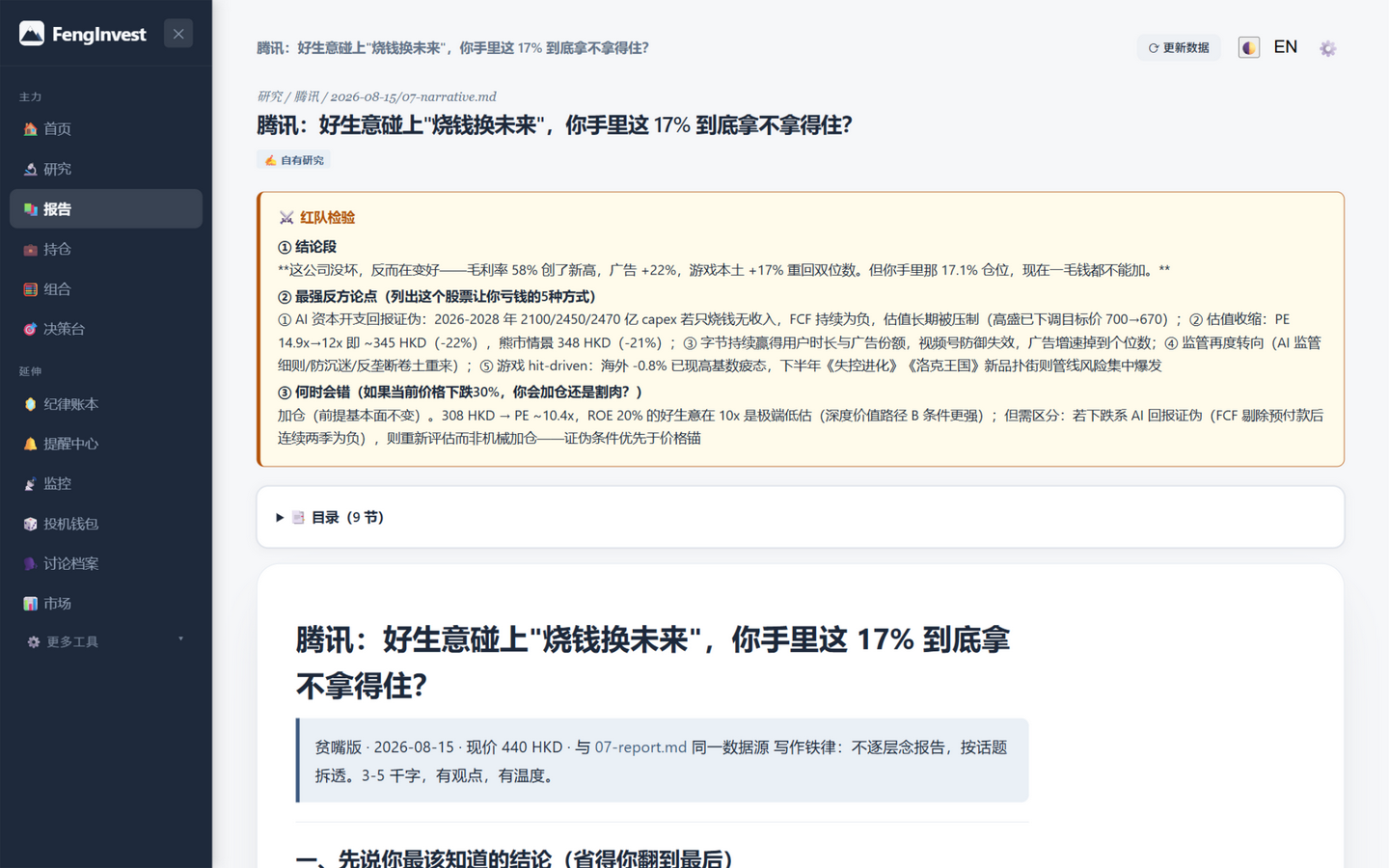
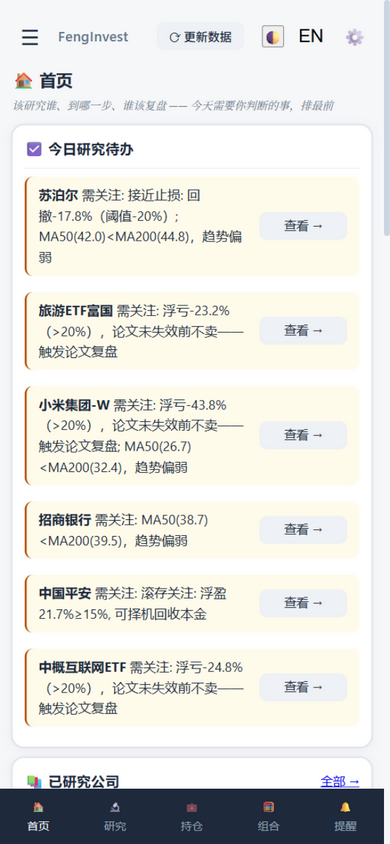
- Web UI: analysis progress and report visualization—a toolset built for day-to-day research.
Quick Start
A state-machine tool—a few commands run the whole analysis flow.
python tools/fengstate.py init <TICKER>— initialize analysispython tools/fengstate.py check <TICKER> <layer>— check prerequisitespython tools/fengstate.py complete <TICKER> <layer> <file>— mark completepython tools/fengstate.py status <TICKER>— view progresspython tools/fengstate.py verify <TICKER>— full verification
The engineering realization of the investment framework starts here
Back to the Investment Framework →